6 Thoughts on the Hungarian Election
Let's hope pot-belly-fat-head is the first domino to fall.


I’ve obviously been listening and reading all the rightfully jubilant coverage of the Hungarian election, here are some of my take aways
#1 At some point, even if you’re popular people just get sick of you.
Sixteen years is a very long time to be in office. Yes, there is a worldwide backlash against incumbents, but at some point people just want something new, even if things are good, but especially if they’re not great.
#2 You can’t disguise corruption and bad governance with culture war shit forever.
Yelling about the gays, the immigrants and Brussels doesn’t work forever. When people start to notice all of your cronies are living in palaces and institutions they rely on are broken, they will come for you.
“On corruption, too, he did something interesting. Normally when politicians talk about corruption, they talk about big companies, they talk about billions. But ordinary voters outside the big cities don’t think in terms of billions—billions do not exist for them. Magyar focused on corruption in the health system, corruption in things that people can actually understand. On that level, he was a very traditional politician, going to people and saying, “I am doing what you asked me to do.” But he also knew very well where the consensus lay.”
- Ivan Kratsev speaking to Yasha Mounk
 Yascha Mounk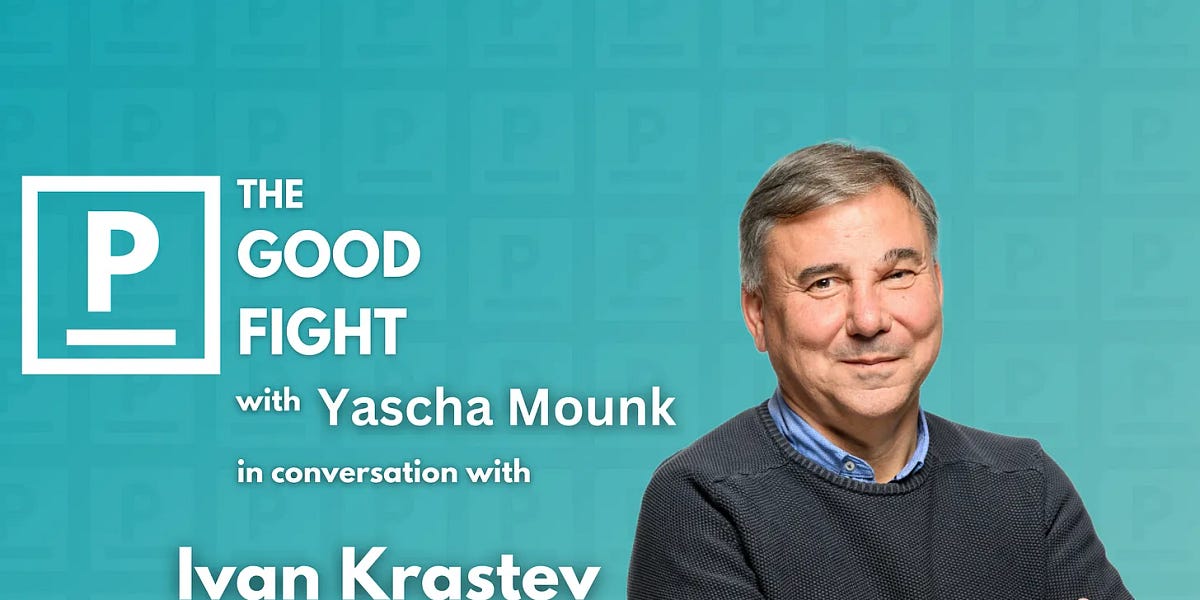
From Peter Dosa of The Hungarian Report:
“But the most important thing he said was the simplest. Politics should be service. In most countries, that registers as a cliché. In Hungary, after everything, it sounds almost dangerous. Service instead of extraction. Accountability instead of protection rackets. A government that exists to answer to the country rather than feed off it. He knows it is easy to say. So does everyone in the room. The struggle now is inside the state itself, in every ministry and agency and sealed file that the last government preferred to leave undisturbed.”
And from The New York Times
#3 Anyone with eyes can see this is a dangerous world, and there is safety and power in numbers - especially for small countries.
Orbans strategy of antagonizing the EU and effectively selling his veto to Moscow, Beijing and D.C. may have been exciting at the begining. He was really sticking it to the man, or as it were, the globalists. But voters saw what happened with Greenland, and felt the squeeze of badly needed EU funds that were being held up because of Orbans antics and said, well, maybe the EU ain’t so bad afterall.
"What struck me most in Péter Magyar’s answers in his press conference today was his attempt to sketch the kind of country Hungary might wake up to the morning after.And nowhere was that clearer than on Ukraine.This, to my mind, was the day’s most significant intervention. Magyar said, without hedging, that Ukraine has every right to defend its borders and sovereignty, and that no outsider is entitled to dictate which pieces of its territory it should forfeit. Once, this would have been self-evident. Under Orbán, it became negotiable. Magyar put the obvious back on the table. He did not stop there. Magyar suggested that anyone urging Ukraine to surrender land should answer a simple question: if Russia invaded Hungary, which county would they be prepared to hand over? It was a blunt instrument, and deservedly so. In a single sentence, he sliced through years of Fidesz’s oily sophistry. For too long, Orbán’s circle has tried to rebrand capitulation as realism. Magyar named it for what it is. This matters for its moral clarity and because it restores a measure of dignity to Hungarian political speech. This is a country that remembers 1956. It deserves better than leaders who speak as if small nations must accept amputation whenever great powers insist.”
#4 Looks matter
Are we surprised that young hot jacked guy beat old pot bellied fat head? Orban’s increasing corpulence over the years just looked like corruption. You could practically see him feeding at the trough.
Forget about all the high minded talk of liberal democracy, If you did nothing else but look at the election coverage on TV or social media on mute, the winner would be a forgone conclusion.
#5 IRL still matters
This point struck me. Magyar criss crossed the country for two years talking and listening to people. Now in Hungary, that’s easy to do, it’s smaller than New Jersey with a population no bigger than Queens and Brooklyn combined. We areflesh and blood human beings (for now!), as well as social animals and social media alone won’t to it.
#6 We have to form a united front
I’ve noticed a lot of voices warning ‘He’s not a liberal, let’s see what he does’ and that caution may be warranted. But that is also not the point. I don’t care if he doesn’t go to Pride parades as long as he doesn’t actively forbid them.
Or people like Orban loyalist and American post-liberal Rod Dreher doling out cope and suggesting that at least Magyar crushed the left in Hungary.
Not so fast. The left exists, but many of them - true patriots - understood that Magyar was the most likely candidate to defeat Orban, so they didn’t run.
I’ve heard this from multiple sources which I’ve since forgotten, so I checked with Perplexity:
“Did progressive parties in Hungary stand down and so a united front could form to support Magyar”
Answer:
Yes—several progressive and left‑leaning parties in Hungary effectively stood down and refrained from running in the 2026 parliamentary election so that opposition votes could coalesce behind Péter Magyar’s Tisza party, creating a de facto united front against Viktor Orbán.
Which parties stepped aside
- In early 2026, multiple established opposition parties—including the Hungarian Socialist Party (MSZP), the green party LMP (“Politics Can Be Different”), the liberal Momentum, and others such as Second Reform Era Party and the Dialogue movement—announced they would not contest the parliamentary election.
- The Socialist Party explicitly justified this by saying the only way to beat Fidesz under an “unfair” electoral system was to unite behind the “strongest opposition candidate,” implicitly backing Magyar without fielding their own list.
How this created a united front
- These withdrawals left Tisza as the main anti‑Orbán vehicle, absorbing much of the traditional opposition vote and allowing the anti‑Fidesz electorate to rally around a single brand instead of fragmenting across many small parties.
- Analysts describe this as a “united front under one banner” strategy: progressives and greens did not formally merge into a joint coalition list, but they effectively helped create a single big‑tent opposition vote that Magyar channeled into a landslide victory.
So the answer is: yes, most progressive parties basically suspended independent list‑level competition in 2026 and let votes consolidate behind Magyar’s Tisza, which functioned as a united front even though it was not a formal cross‑party coalition.
Let's hope Orban is the first domino to fall.